What a trip: research suggests mushrooms talk to each other with a vocabulary of 50 words


You might have stepped and (mentally) tripped on some, but you would’ve never considered that mushrooms could be terribly talkative in the forest. Now, a new study suggests that fungi in general are always communicating with each other. In fact, they have even been recorded having conversations in a language similar to human speech.
But before we regret all our shroom hunting trips, let’s analyse how individual fungi, even after being separated from each other, are capable of interactions in the first place. Well, their secret to communication lies in electrical impulses—which are conducted by fungi through long, underground filamentous structures called hyphae, similar to how nerve cells transmit information in us humans. Call hyphae the internet of the woods, if you may.
In fact, previous research has shown that the firing rate of these impulses increase when the hyphae of wood-digesting fungi come into contact with wooden blocks. This has raised questions if fungi use this electrical language to share information about food and warn parts of themselves—or other hyphae-connected partners like trees—about potential threats. But does this communication pattern have anything in common with human speech?
After finding that slime mould exhibited cognitive abilities with spikes of electrical activity, professor Andrew Adamatzky from the Unconventional Computing Laboratory at the University of the West of England was curious to see if fungi did the same. In his study, published in the peer-reviewed journal Royal Society Open Science, Adamatzky analysed the patterns of electrical spikes generated by four species of fungi: enoki, split gill, ghost and caterpillar.
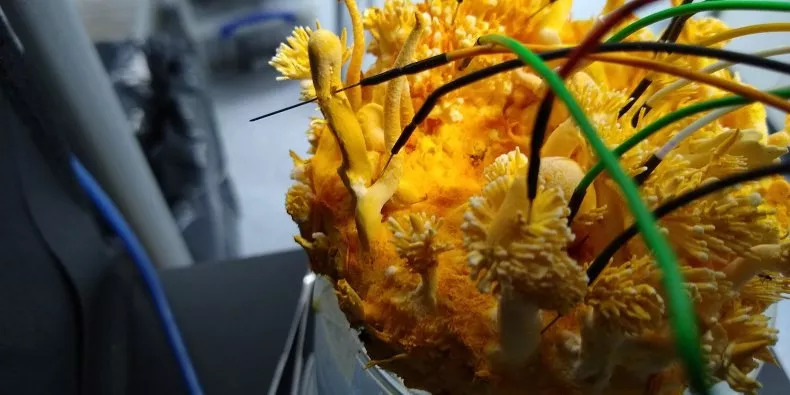
“We do not know if there is a direct relationship between spiking patterns in fungi and human speech. Possibly not,” Adamatzky wrote. “On the other hand, there are many similarities in information processing in living substrates of different classes, families and species. I was just curious to compare.”
The results were surprising, to say the least. Adamatzky found that the electrical spikes often clustered into trains of activity, resembling vocabularies of up to 50 words. The professor also noted that the average length of each ‘word’ spoken by the fungi was 5.97 letters, while the English language averages 4.8 letters per word. According to Adamatzky, this ultimately proves that the species has a mind and even a consciousness of its own.
“Assuming that spikes of electrical activity are used by fungi to communicate, we demonstrate that distributions of fungal word lengths match that of human languages,” he continued. “We found that the size of fungal vocabulary can be up to 50 words, however, the core vocabulary of most frequently used words does not exceed 15 to 20 words.” At the same time, however, the expert also believes the species could be saying nothing at all. “Propagating mycelium tips are electrically charged and, therefore, when the charged tips pass in a pair of differential electrodes, a spike in the potential difference is recorded,” he wrote.
Dan Bebber, an associate professor of biosciences at the University of Exeter and a member of the British Mycological Society’s fungal biology research committee, additionally believes more evidence is required before the scientific community is willing to accept fungi as a form of language. “This new paper detects rhythmic patterns in electric signals, of a similar frequency as the nutrient pulses we found,” he told The Guardian. “Though interesting, the interpretation as language seems somewhat overenthusiastic, and would require far more research and testing of critical hypotheses before we see ‘Fungus’ on Google Translate.”
Adamatzky further highlighted how this process would take time to develop. “We are yet to decipher the language of cats and dogs despite living with them for centuries and research into electrical communication of fungi is in its pure infant stage,” he concluded. Nevertheless, imagine if one day you could Google Translate “I hope you don’t mind me doing this” into a fungi’s language and play it back to them for a guilt-free shiitake hunt.
