The surprising history and original purpose of chainsaws


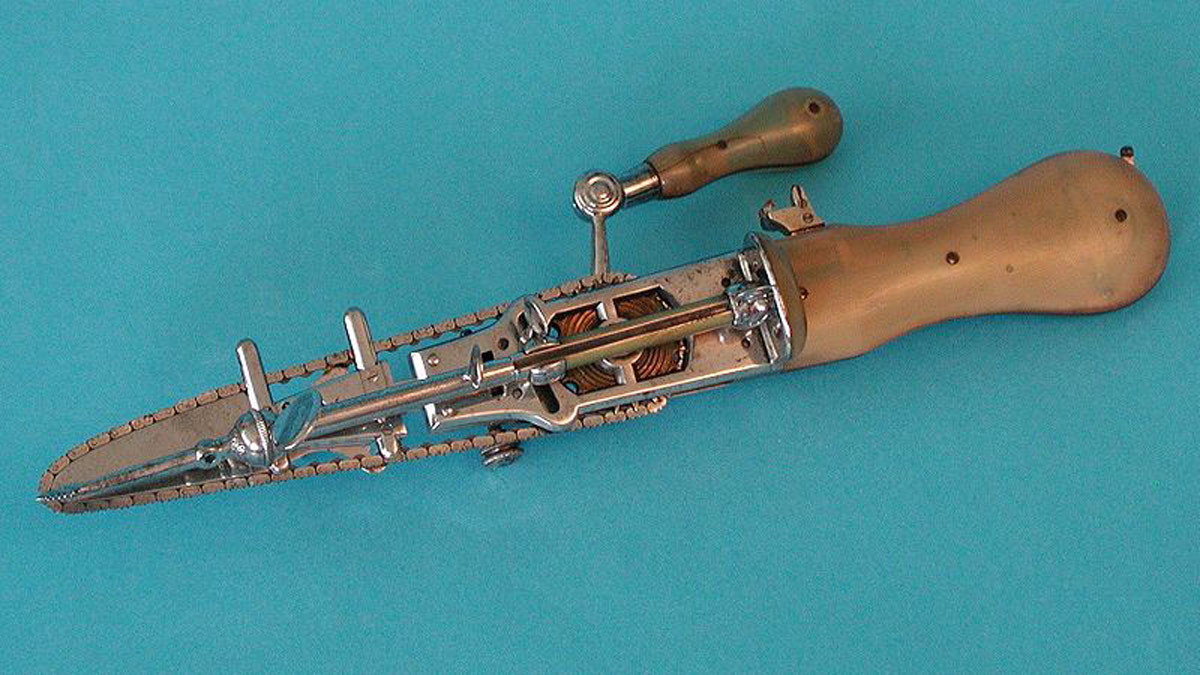
You know what chainsaws are, right? That big electric metal tool that is kind of pointy? The one that cuts through wood? Well, guess what? They weren’t invented for the wood, but for the womb. Simply put, chainsaws were originally invented for assisting childbirth. You’re probably clenching your legs together after reading that. I definitely am. Giving birth already seems like an unpleasant experience—to put it lightly.With a chainsaw you’ve got a horror movie. I’m thinking, Texas Chainsaw Massacre.
According to Popular Science, chainsaws were invented during the 18th century by two Scottish surgeons John Aitken and James Jeffray. Prior to the advancement of medical procedures like caesarean sections (considered dangerous due to the risk of infection), access to anaesthesia (it wasn’t perfect at the time) and other tools, babies had to be born naturally—duh, right? However, babies can sometimes get their limbs stuck in parts of the pelvic on their way out. The solution to this problem was defined as a ‘symphysiotomy’ at the time.
This was a medical procedure that involved cutting and removing some bone and cartilage in order to widen the birth canal during complicated births. Before the invention of the chainsaw, doctors would conduct this procedure with a regular saw (small in size) and a knife. Without anaesthesia. This would have proved a tortuous process for the soon-to-be mother, if she even made it that far. Sorry, that was morbid, but it’s the 1780s and they’re literally cutting bones out.
@site_42 #stitch with @matthewsantoro Knew how it was gonna go, still unhappy. #scptiktok #drsherman #site42 #chainsaws #whywerechainsawsinvented #patriarchy
♬ original sound - Dr. Theron Sherman
It was because of this obviously horrifying experience for the woman giving birth that Aitken and Jeffray began the development of their chainsaw—they were actually trying to make the cutting process easier, quicker and thus lessening the agony. The first model of the chainsaw consisted of a long chain with serrated teeth with handles on either end. While wrapped around the pelvic bone, doctors would alternately pull on each handle. This recurring movement outperformed the knife and was much faster in slicing through bone. This was later ‘improved’ through the addition of ‘hand crank,’ allowing the chain to rotate and thus becoming more like the chainsaw we know today.
Mental Floss wrote “Thanks to this innovation, difficult births could be described as merely agonising as opposed to extended torture.” Given the effectiveness of the device in cutting through bone, it remained in use through much of the 19th century—not only for childbirth but for other medical circumstances like amputation. Thankfully symphysiotomy is now an outdated surgical procedure.
All jokes aside, we can talk about how uncomfortable it makes us feel or how ridiculously shocking it is but at the end of the day there are real victims of symphysiotomy. Real women were put through an incredibly torturous and scarring process and they weren’t all from the 18th century. There have been horrifying accounts that over 1,500 women in the Republic of Ireland were unknowingly ‘symphysiotomically’ operated on without their consent between 1944 and 1987. That’s less than 40 years ago. Reports have suggested that this was largely encouraged and conducted by the Catholic Church—which reportedly preferred the method over cesareans.
Victims of the practice, mother and daughter, Matilda Behan and Bernadette founded the organisation Survivors of Symphysiotomy (SOS) in 2002. The group later gained momentum and caught the attention of the Irish Human Rights Commission. In 2008, the commission advised the government to set up an independent inquiry into the medical scandal—but the Minister of Health refused.
However, 2012 proved to be a marker of success for SOS and the survivors seeking justice. SOS cited the example of Olivia Kearney who was “awarded 325,000 euros in her court case against Doctor Gerard Connolly—who performed a post-caesarean section symphysiotomy on her in 1969. The court ruled that in 1969, symphysiotomies were no longer approved.”
While the procedure is still being used in some countries, the number of symphysiotomies as a whole is on the decline. Let’s keep the chainsaws for cutting down trees, shall we? Or better yet don’t use it at all. We’re in the middle of a climate emergency anyway.
Good morning everyone I just read the childbirth chainsaw thread and am very pleased to announce that I have clenched my thighs together so hard that I am legally considered a mermaid ✨🧜
— sophia of hangover (@aethelfleds) January 22, 2020
