How TikTokers are tweaking conspiracy theories to match their pop culture



Do you remember Pizzagate, the conspiracy theory that resulted in Frazzledrip and QAnon? It went viral during the 2016 US presidential campaign, when rightwing news outlets and influencers promoted the idea that a pizza restaurant located in Washington DC (mentioned in stolen emails of Hillary Clinton’s campaign manager John Podesta) was actually a secret code for a child trafficking ring.
If you do remember it, then you’re probably not one of the many TikTokers who have now decided to tweak Pizzagate’s background story in order to match it better to the popular culture they grew up with. Although the conspiracy theory pretty much died on the day it influenced a man to drive, armed, to the pizza restaurant and ‘rescue the children’, only to realise that nothing dodgy was going on there and get arrested, Pizzagate is “catching on again with younger people on TikTok and other online hangouts,” as The New York Times reported. Why exactly is that?
In the years after the pizzeria incident (and shooting), Facebook, Twitter and YouTube all managed to largely suppress Pizzagate—at least, as well as they could. But in July 2020, just months before the next presidential election, the conspiracy theory started making a comeback on these platforms, along with new ones such as TikTok.
This time, the conspiracy theory’s revival is being fueled by a younger generation that is active on TikTok, Instagram, as well as on other social media platforms. According to The New York Times, “The conspiracy group QAnon is also promoting Pizzagate in private Facebook groups and creating easy-to-share memes on it.” Due to the nature and novelty of these platforms, the theory has now been morphed.
Gen Zers don’t actually care about Hillary Clinton, and instead are now targeting powerful businesspeople, politicians and celebrities, including Justin Bieber, Ellen DeGeneres, Bill Gates, Oprah Winfrey and Chrissy Teigen. Additionally, the theory has also gone global, when it initially took place in the US mainly. Now, videos and posts about it have racked up millions of views in Italy, Brazil and Turkey.
According to The New York Times, in July 2020, TikTok posts using the #Pizzagate hashtag had been viewed more than 82 million times. If you try looking up the hashtag today, you’ll see that the app has since then banned it. Meanwhile, Google searches for Pizzagate have skyrocketed. After scrolling down to see Google’s related topics, keywords such as “Ellen DeGeneres – American comedian” and “Chrissy Teigen – American model” come up.
In the first week of June 2020, comments, likes and shares of Pizzagate also spiked to more than 800,000 on Facebook and nearly 600,000 on Instagram, according to data from CrowdTangle, a Facebook-owned tool for analysing social interactions. That compares with 512,000 interactions on Facebook and 93,000 on Instagram during the first week of December 2016.
Gen Zers, many of whom are just forming political beliefs, are particularly susceptible to Pizzagate—they are drawn to celebrity photos on tabloids and platforms where users are supposedly analysing secret symbols and clues. Even a triangle, which can signify a slice of pizza, can be taken as proof that a celebrity is part of a secret elite cabal.
In Bieber’s case, many believe that he has been a victim of the child-trafficking ring known as Pizzagate. Four minutes into a video that was posted on Instagram in May 2020, Bieber leaned into the camera and adjusted the front of his black knit beanie. For some of his 130 million followers, it was a signal.
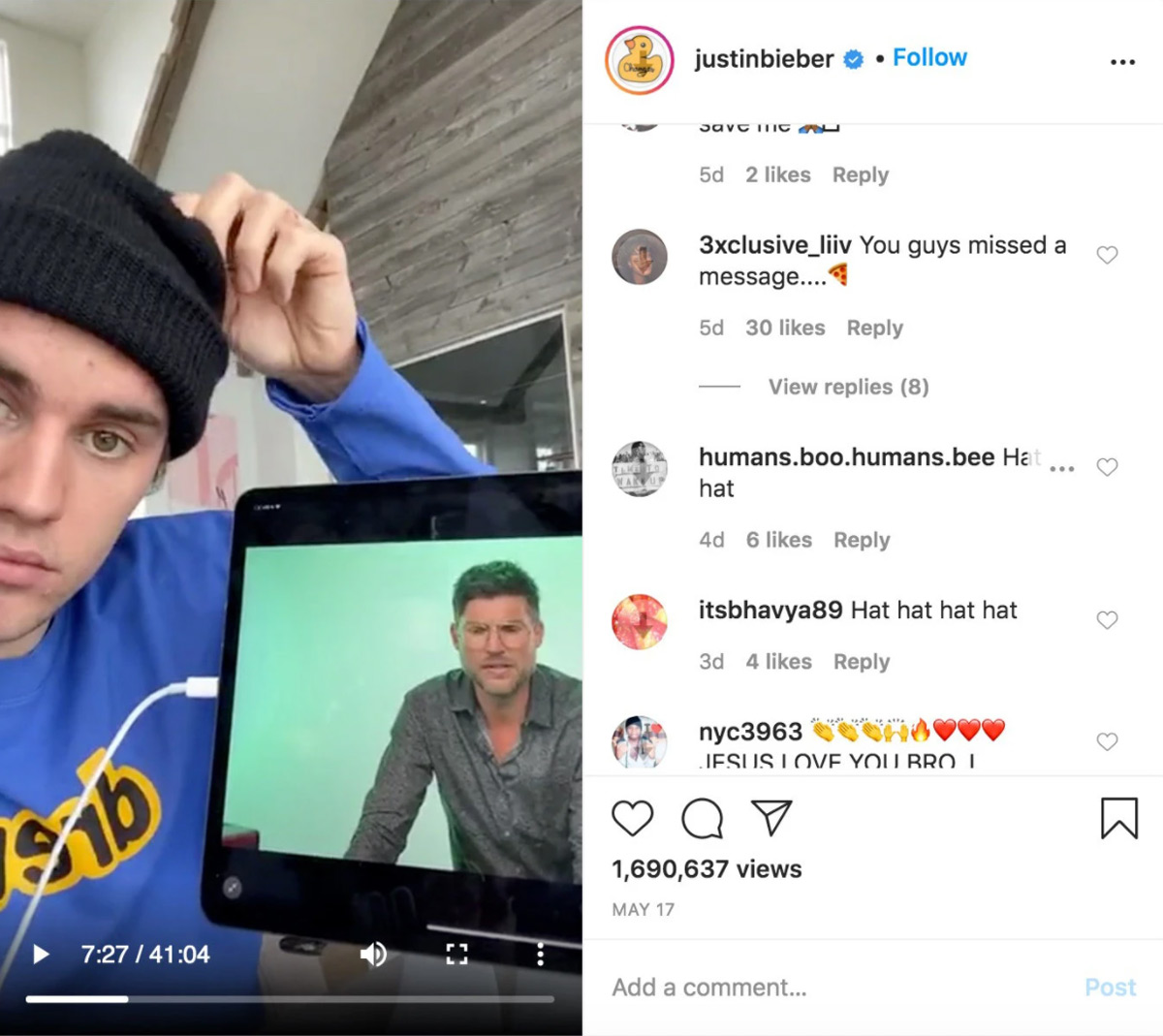
In the video’s comments, someone had asked Bieber to touch his hat if he had been a victim of Pizzagate. Thousands of comments were flooding in, and there was no evidence that the singer had seen that message. But soon enough, the pop star slightly touched his beanie, setting off a flurry of online activity, which highlighted the resurgence of one of social media’s early conspiracy theories.
By tweaking the original theory behind Pizzagate, younger people on TikTok have managed to make the initial conspiracy theory more relatable for them. Although social media giants have become better at stopping false conspiracies like this one, it has also become clear that people who want to spread conspiracies are figuring out workarounds.
Meanwhile, tech companies’ algorithms keep on sucking people further into these false ideas, and TikTok is not proactively moderating its content either—only removing content after journalists reach and point it out. After all, as professor of psychiatry Joe Pierre, MD previously wrote for Screen Shot, “So long as we come to hold beliefs based on intuition, subjective experience, and faith in trusted sources of transmitted information, independent of veracity, conspiracy theories will continue to flourish.”
