How Animal Crossing: New Horizons became our digital backyard during quarantine



Animal Crossing: New Horizons has been the ‘it’ game of quarantine. Instagram stories have been speckled with pastoral, serene screenshots of avatars sitting by the water’s edge with a checkered picnic or stopping to smell the swaying roses in a MiuMiu SS2020 sundress. In spite of quarantine, Animal Crossing has allowed players to blissfully engage with the outdoors through an infinitely explorable landscape, expanded even further by this edition’s inclusion of an in-game smartphone. Despite these updates, the interface is still cosily familiar and quaint, like a replacement for your hometown—assuming you’re having to quarantine miles away from your own.
Many have examined the economics which are at the foundation of the beloved game, as its premise is based around your avatar’s debt, which is considered in the article The Quiet Revolution of Animal Crossing by The Atlantic’s video game correspondent, Ian Bogost. Bogost points out that, Animal Crossing has taught to his son what a mortgage was before ever buying a house—as it did with many current college students.
Naomi Clark—game teacher, designer and scholar at NYU—discussed the specific socioeconomic atmosphere in which the game first emerged from in a short lecture last week. In the late 90s and early 00s, Japan was emerging from a detrimental recession. As urban areas became increasingly crowded, the idea of the pastoral—the mountains, countryside, or beach, all of which are easily accessible from any point of Japan’s geography—became highly sought after and admired.
This is reflected in how the game is centred around the adoption of the main player into a community of animals. The human returns to a natural, cohesive community of flora and fauna in stark contrast to the concrete cityscape. The player then becomes further glued to the community through collective debt, which Clark points out is a reality of 18th century Japanese fishing villages. Debt, in this case, is what binds you to the community. Without it, there would be no game.
The absence of a straightforward narrative in the game encourages exploration of the space. Though grounded in debt, it’s essentially a highly idyllic economic space where you’re paid for whatever work you decide to do—whether that be catching butterflies or harvesting tarantulas—but aren’t penalised for sitting on a tree stump all day and watching cherry blossoms float by.
The idyllic economy is especially present in Animal Crossing: New Horizons compared to past renditions of the game due to the level of customisation available. Players are able to decorate themselves and their spaces in designer brands or artworks they admire—luxurious items that users aren’t able to afford or interact with in reality.
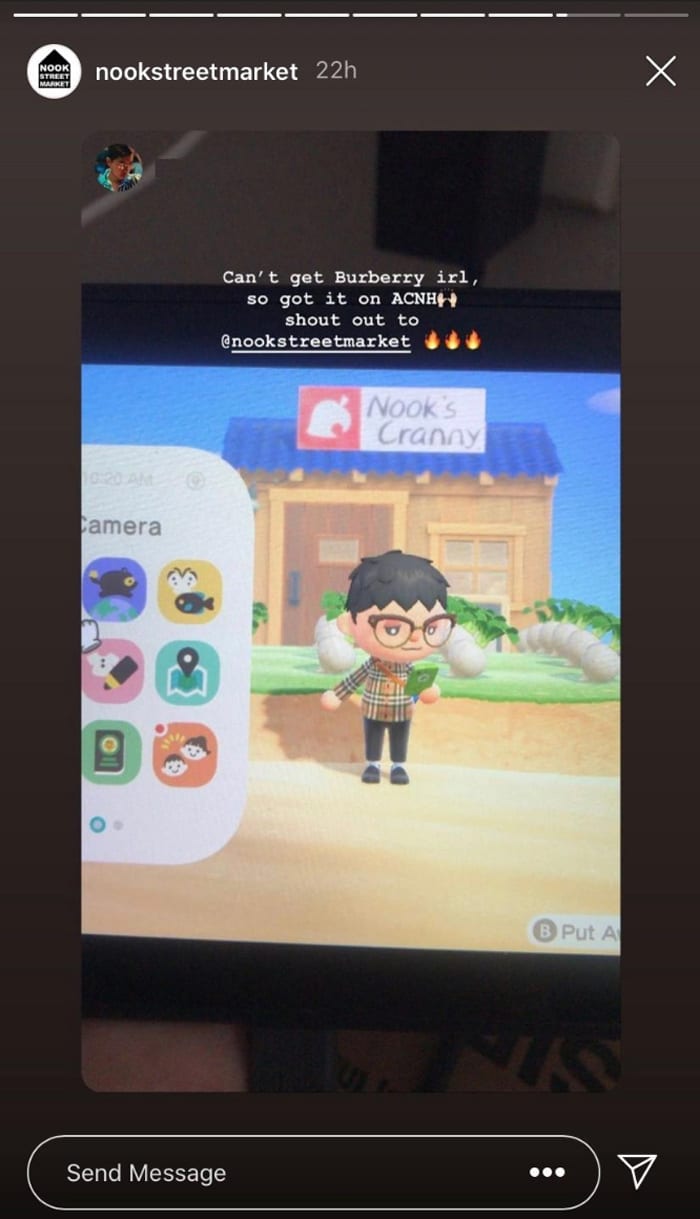
The rise of game boutiques such as Nook Street Market further facilitates the presence of designer clothing in the game’s world. For instance, in this screenshot taken from the account’s Instagram this past week, one player notes how they “can’t get Burberry irl, so got it on [Animal Crossing].” Player customisation and creation in and outside of the game is encouraged, allowing for an idyllic version of our own world to be reflected.
Similarly, the sweeping, buzzing fields and full, undulating fruit trees represent another kind of financial inaccessibility for most in urban populations. Dirt, and its associations with the organic and natural, has become a luxury item. According to a research paper in the British academic journal Biology Letters in 2016, “in urban ecosystems, socioeconomics contribute to patterns of biodiversity.” Socioeconomic statuses of residents in an urban area then produce a “‘luxury effect’, in which wealthier neighbourhoods are more biologically diverse” in plants, animals and insects.
This is demonstrated by the cordoned off gardens around Kensington and Chelsea, one of London’s wealthiest boroughs, which are only accessible for those who live in the limestone townhouses around the squares. A recent article by Huck Mag similarly echoes this with the author pointing out how multiple public spaces in London have been shut down due to coronavirus. The piece suggests opening up golf courses as more public outdoor space for those in the city who don’t have a garden or balcony.
While of course it’s difficult to ensure social distancing is maintained, it’s also important to recognise not only the physical but also mental breath of fresh air being outside provides. Outdoor space has become a privilege attached directly to income in the cramped contemporary city, which has become more blatant through the unprecedented measures of lockdown in which people are confined to the spaces of their property.
However, for the price of a Nintendo Switch and an Animal Crossing cartridge you can access a resemblance of this. Due to the quarantine measures globally, art and culture have moved to online spaces, but, similarly, the digital flora and fauna in Animal Crossing has become a virtual backyard or park space.
When you can’t build vertically or horizontally in a cityscape anymore, why not build into the cloud? With or without the pandemic or a recession, Animal Crossing still remains an idyllic space. Not only because it’s rooted in nostalgia, but because of these inaccessible elements which players are allowed to roam freely within and among in the game space. New Horizons offers plushy, CGI horizons that extend beyond our flat’s window frames.
