Le Pen predicted to beat President Macron in 2022 French presidential election



For the 2022 French presidential election, the country will probably repeat history—at first at least. According to an Ifop survey conducted for the newspaper Le Journal du Dimanche, Emmanuel Macron and Marine le Pen would be, just like in 2017, the two candidates headed for the second round of the presidential election if the vote took place today. To date, none of this sounded too surprising. But now there’s more.
A new Harris Interactive poll commissioned by CommStrat cabinet and the daily L’Opinion found that, depending on the various potential candidates on the right and the left of France’s political sphere, Emmanuel Macron could lose to Marine Le Pen by a short header in the first round. Here’s why this potentiality is terrifying for an already divided country.
The French President would gain 23 to 24 per cent of the votes against the 26 to 27 per cent that Le Pen could secure, the poll found. To put things in perspective, in 2017, Emmanuel Macron won 24 per cent of the votes in the first round, against 21.3 per cent for Marine Le Pen. And as mentioned above, the French presidential election next year is expected to see the pair at the centre of the debate again since so far, no one ‘promising’ has appeared in France’s presidential landscape.
In simpler terms, other potential candidates remain far behind for now: Xavier Bertrand, former Minister of Labour, Employment and Health, has publicly expressed interest in challenging Macron in the upcoming election. According to recent polls, he would gain 15.5 to 19 per cent of the votes in the first round.
And yet Bertrand is still predicted to ‘do better’ than other candidates from The Republicans (LR)—the country’s liberal-conservative party, previously known as the Union for a Popular Movement (UMP). François Baroin, who served as Finance Minister from 2011 to 2012, is predicted to gain 14 per cent of the votes, while Valérie Pécresse would reach 11 per cent, and Bruno Retaileau and Paris Rachida Dati even less.
Things are looking even more bleak for The Socialist Party (PS)—the largest party of the French centre-left. So what about Marine Le Pen, the president of the National Rally (RN) political party (previously named National Front)? When she lost to Macron in the second round of the 2017 election with 33.9 per cent of the votes against 66.1 per cent won by the President, the French youth heaved a collective sigh of relief.
Described as more republican than her nationalist father Jean-Marie Le Pen, she has led what many have called a movement of “de-demonization of the National Front” to soften the party’s image by renewing teams and expelling controversial members accused of racism, antisemitism, or Pétainism. Le Pen went as far as expelling her own father from the party on 20 August 2015 over new controversial statements he made (and had been for years before).
Does that mean that the National Rally has finally put its long history of racism and antisemitism behind? Far from it, despite a push by the party to soften its xenophobic and racist image to broaden its appeal with voters. An investigation conducted by Al Jazeera in 2018 revealed close ties between the violent far-right group Generation Identity (GI) and Marine Le Pen‘s National Rally. In a secretly-filmed footage, Aurelien Verhassel, the 34-year-old leader of GI Lille, claims to have written speeches for leaders of the RN, and was shown to have ties to Le Pen’s aide, Sebastien Chenu.
Other far-right activists from Bordeaux claimed they provided security for RN leaders during the 2017 presidential election while RN members professed support for a “civil war” during visits to a private bar run by Verhassel, called the Citadelle. Le Pen continued to deny links between GI and RN.
Meanwhile, President Macron has shifted his rhetoric to the right in recent weeks, attempting to pass new laws to drive home his emphasis on law and order. As a result, the new policies on security, law and order have sparked a heated debate in France—highlighting major divisions in the country.
Macron will be looking to avoid a result similar to that of the European elections in 2019, where his rivals mopped up much of the rural and deindustrialised areas of northern, south-central and eastern France.
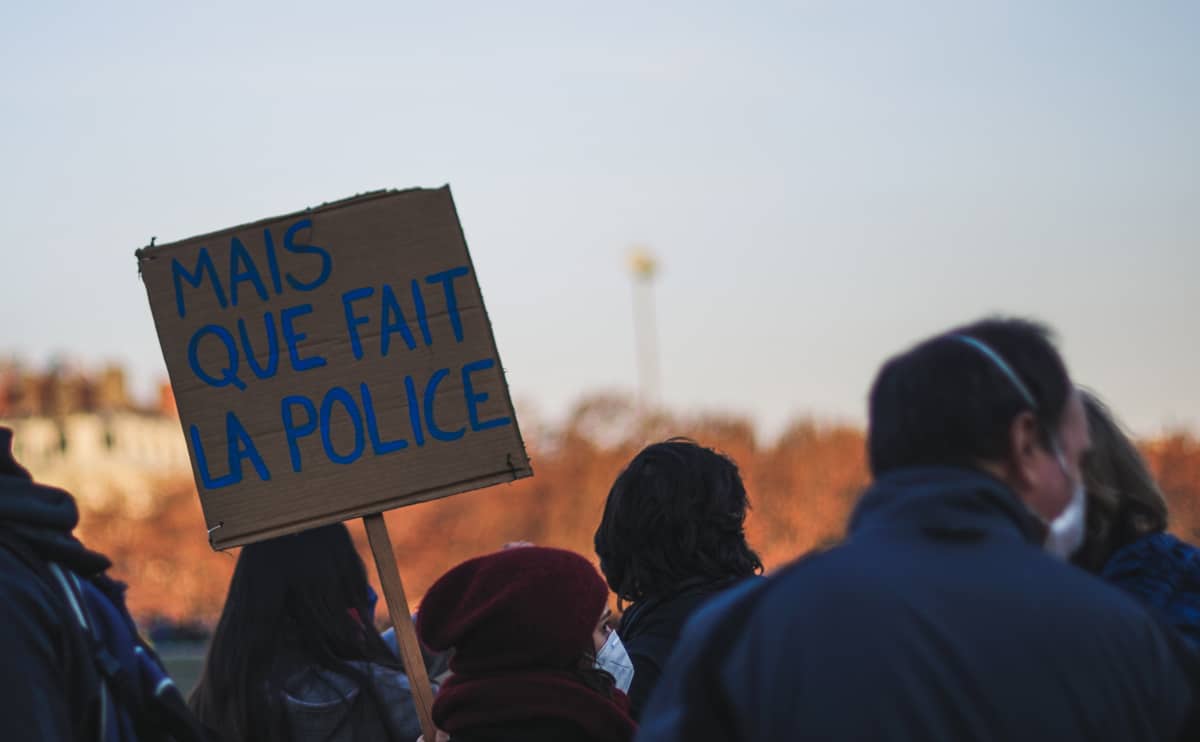
The French President also faced backlash for his new laws aiming to restrict protests, protect police and combat radicalism. The legislation aimed to increase police protection, making it a criminal offence to publish images of on-duty officers with the intent of harming their “physical or psychological integrity.”
Around the same time, footage showing police beating a black music producer in Paris was released as the latest addition to a series of acts of police violence that rocked the country. As a response, around 133,000 to 500,000 people demonstrated in more than 70 cities across France against the proposed security law. Eventually, Macron succumbed to public pressure, and ditched the controversial bill.
Although we’ve learned not to fully trust what polls predict, this prediction in question is as dreadful as Trump’s win in 2016—and both possibilities are somewhat underwhelming. But look on the bright side (if you can), we still have 13 months to go…
