Gaza journalist death toll surpasses that of both World Wars, following latest Israeli airstrike that killed reporter



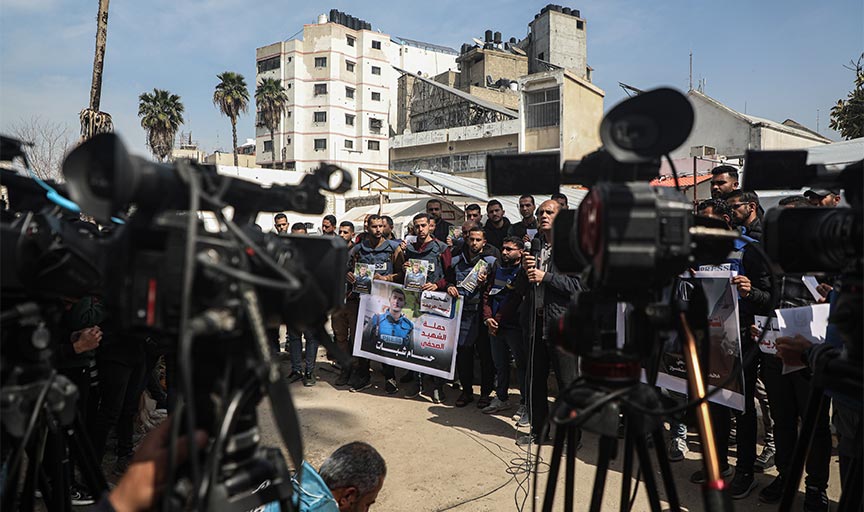
In another devastating attack, Israeli forces targeted a tent housing journalists near Nasser Hospital in Khan Younis, Gaza, early on Monday 7 April 2025, resulting in the deaths of at least two media workers and injuring seven others. This bombing is part of a continued escalation, following Israel’s military strikes that killed over 43 people in Gaza and forced the evacuation of residents from five neighbourhoods in central Deir el-Balah.
The death toll of journalists in Gaza surpasses that of both world wars
The number of journalists killed in Gaza since October 2023 continues to climb, with the Government Media Office reporting that 232 journalists have now lost their lives due to Israeli attacks. Among the latest casualties is journalist Ahmed Mansour, a father and reporter for Palestine Today, who was burned alive in the same bombing at the Khan Younis hospital.
BREAKING: More journalists have died in Gaza since Oct. 7, 2023 than in both World Wars and other major wars, combined.
Our new report outlines the costs of war to journalists – and the journalism we all rely on. [THREAD, 1/8] https://t.co/oeeqPqw5i2 pic.twitter.com/gSXWYjtXSl
— The Costs of War Project (@CostsOfWar) April 1, 2025
Updates about journalists conditions after Israeli attack:
➡️Journalist Hilmi Faqaawi was KILLED
➡️Journalist Ahmad Mansour is suffering severe and critical burns and wounds
➡️Hassan Slayyeh is suffering from crushed fingers in his right hand and moderate head injuries. He… pic.twitter.com/0lNKNbiDpS
— Motasem A Dalloul (@AbujomaaGaza) April 7, 2025
This attack raises further alarm about the dangers faced by journalists in Gaza, as the conflict has turned into the deadliest for media workers in recorded history. A report published by the Watson Institute for International and Public Affairs on 1 April highlighted the staggering statistic that 232 journalists have been killed in Gaza since 7 October 2023. This is more than the total deaths of journalists in both World Wars, the Vietnam War, the wars in Yugoslavia, and the US War in Afghanistan combined, let that sink in for a moment.
New research shows Israel's slaughter in Gaza has killed more journalists than the US Civil War, World Wars 1 and 2, the Korean War, the Vietnam war, the Yugoslav Wars, the Afghanistan War and the Ukraine War COMBINED.
More: https://t.co/YJi8bdIm9Y pic.twitter.com/p8XJSZpj3a
— Jonathan Cook (@Jonathan_K_Cook) April 1, 2025
The unprecedented death toll for journalists
This war has brought the highest number of journalist deaths ever recorded, with an average of 13 journalists killed each week since the conflict began. It is not just a matter of statistics; these are individuals killed while carrying out their essential work of documenting the human toll of war.
While some journalists may have been directly targeted by Israeli forces, it is unclear how many have simply fallen victim to the indiscriminate bombardment that has ravaged Gaza. According to Reporters Without Borders (RSF), there have been 35 cases where it is likely that Israeli forces deliberately targeted journalists due to their work, including the tragic death of Al Jazeera reporter Hamza Dahdouh on 7 January 2024.
The escalating number of journalist deaths highlights an alarming shift in the role of media in conflict zones—where those trying to tell the world what is happening are increasingly becoming victims of the violence themselves. With the latest attack near Khan Younis, the death toll continues to rise, and Gaza remains one of the most perilous places on Earth for reporters.
It’s important to note that the recent attacks on journalists in Gaza, where nearly no foreign correspondents have been granted access, have intensified a troubling trend. Local reporters—often underpaid and under-resourced—are now facing the greatest risks in the region.
As foreign media presence in Gaza is nearly impossible, the responsibility of documenting the ongoing war falls increasingly on local journalists, who are working with limited resources and facing mounting dangers. The Costs of War report highlights that this trend is not unique to Gaza, but is part of a broader global issue where the economics of the journalism industry, the violence of war, and coordinated censorship campaigns are turning more conflict zones into “news graveyards.” Gaza, however, stands as the most extreme example of this growing crisis.
During a powerful discussion at an event I attended, Women in War, Christina Lamb, chief foreign correspondent of The Sunday Times, shared a poignant memory of a fellow journalist, Victoria Amelina, who died covering the conflict in Ukraine. Responding to a question I asked regarding her own invaluable work, Lamb noted: “We must continue to be shocked and never lose that sense of astonishment in the face of injustice. Let’s keep reporting, and keep fighting for the things we believe should never be accepted as normal.” Today, I want to take a moment of silence for them—the brave journalists who continue to risk everything to ensure the world knows the truth. Thank you.
