Banning cops from New York City Pride is not a misstep, it’s a necessity


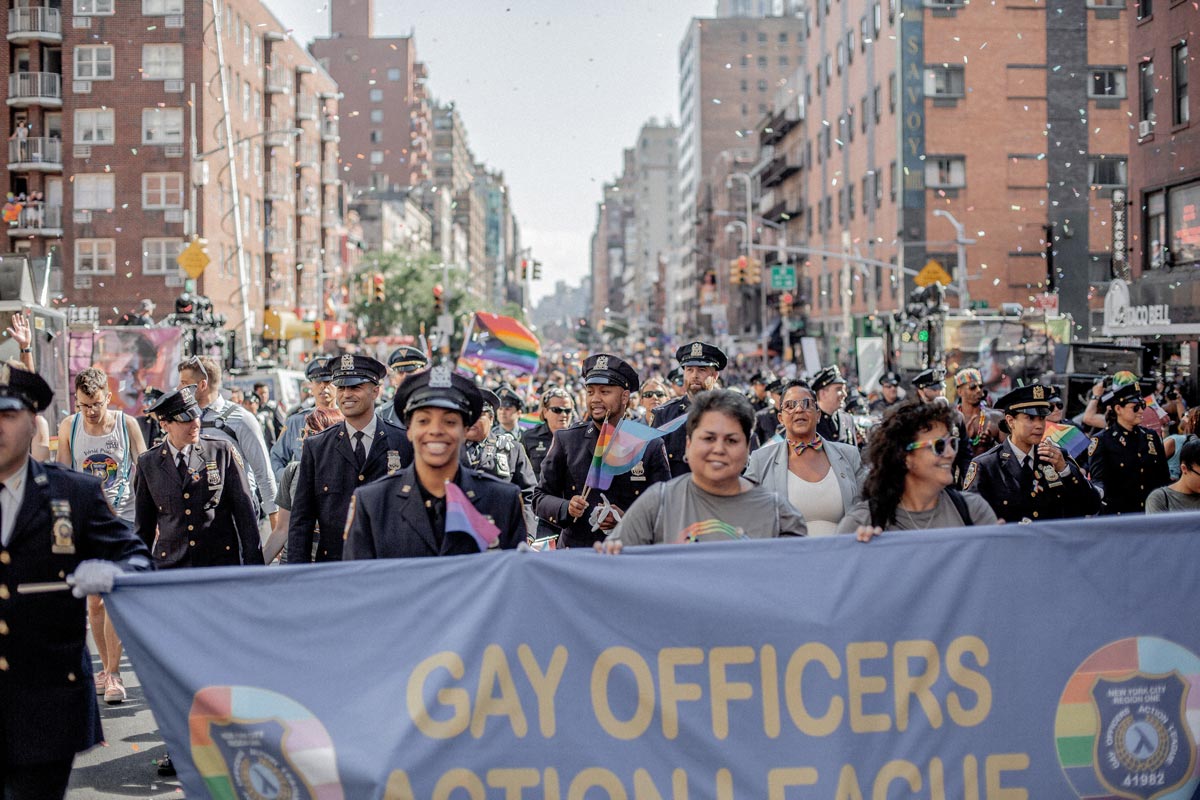
Recently, the organisers of New York City Pride—one of the world’s largest—took significant steps to reduce the presence of police at Pride, banning all uniformed police from participating in the parade until at least 2025. It was a bold decision, but one that has been welcomed by many activists within the LGBTQ+ community.
The New York Times Editorial Board—“a group of opinion journalists whose views are informed by expertise, research, debate and certain longstanding values”—described the decision as a “misstep.” They focussed on “a sergeant in the New York Police Department” who is “also a lesbian” and feels let down by the decision. The article was met with significant backlash on social media, with prominent New York drag queens and activists calling out the authors. The fact that the piece came from the editorial board, and therefore had no individual byline, received ridicule. Several years ago, Teen Vogue published a much more eloquent argument: “Why Police Aren’t Welcome at Pride.”
revisionist history is one hell of a drug lol https://t.co/UgTe2JG7Mc pic.twitter.com/HfylwxGvMO
— matt (@mattxiv) May 19, 2021
Pride—specifically New York Pride, the first in the world—marks the anniversary of the Stonewall Riots, a watershed moment in queer liberation, not just in America but globally. The riots were a reaction by queers (gay men and lesbians, trans and gender non-conforming people, drag kings and queens) against the police, who would harass, intimidate and humiliate the patrons of the bar, one of few venues in the city where same-sex dancing was actually permitted. Raids were common practice. But that one night, they had had enough.
When I was in New York a few years ago for Pride, which marked the 50th anniversary of these events, I walked past the Stonewall Inn. Christopher Park, in front of the pub, which houses a monument to gay liberation, was closed and guarded by NYPD officers with semiautomatic weapons. It felt wrong.
Those criticising this recent decision seem to think it’s as easy to stop being queer as it is to take off a police uniform. Only one of those things is a choice. Being “proud” to be a police officer, to take pride in one’s work, is not why we have Pride parades. It’s similar to the ridiculous argument that circulates from time to time, that coming out as conservative is harder than coming out as gay. Pride is a queer space and queerness is inherently both political and progressive. No one is stopping the individual participation of officers, as such exclusion would go against the principles of pride. But the NYPD are not welcome.
There is, inevitably, a certain unholy alliance formed between organisers and police in order to host an event like Pride: road closures and protection from homo- and transphobic threats tend to come under police jurisdiction. But this is separate from allowing cops to march in uniform as part of a Pride parade, alongside activist groups, grassroots organisations, and LGBTQ+ charities, to name a few. Never mind the increasing corporate presence at these events. Volunteers and community organisers are, more often than not, better suited to sensitively facilitating such LGBTQ+ events.
Halting institutional involvement is an important decision. Institutions—from corporations to state apparatus—will use their involvement in Pride events as a defence against accusations of internal failings with respect to their LGBTQ+ staff, in what is usually called pinkwashing, which is defined as “using gay-related issues in positive ways in order to distract attention from negative actions by an organisation, country or government.” The fact that this decision is set to last until 2025 is significant: it’s not quite an ultimatum, but they are calling for active reform among the NYPD, and giving a generous timeline for such reform to happen.
Toronto and Vancouver have already banned uniformed officers, and several American cities, like Sacramento and St. Louis, have tried to follow suit. It wasn’t until a 1996 lawsuit that the Gay Officers Action League (GOAL) were allowed to fully participate in New York’s Pride parade. GOAL has done significant work to fight discrimination within the police force. But that doesn’t provide universal solutions. And many queer people fear police harassment. Last year, in Washington Square Park, just around the corner from the Stonewall Inn, officers wearing riot gear attacked peaceful protestors with pepper spray, presumably under the guise of enforcing social distancing.
Police at London Pride not only allowed Terfs to hijack the front of the parade march, handing out flyers calling trans women rapists and harassing visibly trans attendees, but threatened to arrest trans people who told them to fuck off.
— Laura Kate Dale - Bluesky @LauraKBuzz.bsky.social (@LaurakBuzz) May 23, 2021
No cops at pride. https://t.co/v0H0Tjpuqs
And, as one Twitter user pointed out, it was only a few years ago that the police at London Pride not only allowed a group of “gender critical” lesbians to hijack the parade, but threatened trans people who reacted to their presence. Pride in London fractured earlier this year, in large part due to the decision to allow the continued involvement of the Metropolitan Police. Systemic issues have been closely looked at in the wake of the Sarah Everard vigil in Clapham. “Pride in London did not uphold its public commitment when it mattered most and failed to set even the most basic conditions on continued police involvement—like an acknowledgement of institutional racism,” wrote the Community Advisory Board, who all resigned in March.
There was no official Pride in London last year, due to the pandemic. Instead, on the same date, there was a grassroots march to raise awareness of and support for Black Trans Lives around the world, an intersectional extension of last summer’s BLM protests. When police arrived—lurking at the sidelines, significant numbers seemingly hidden on side streets—I felt less safe. The draconian Police, Crime, Sentencing and Courts Bill 2021, currently caught up in parliamentary procedure, threatens to make things worse. It’s the great irony of contemporary policing: those who need the most help and protection tend to receive the least. Until that’s solved on a fundamental, institutional level—no cops at Pride.
