New study uses AI to determine which fruit varieties are the most flavoursome of all


Are you on the hunt for more flavourful fruits? Ever wanted to know if the ever so elusive perfect tomato exists? In other words, can the produce industry do more to tickle your tastebuds? I mean, five-a-day is no joke, people. It’s technically still health kick season for those of us who have managed to stay on top of their New Year’s resolutions, especially since the January blues are now behind us. And in case you need a gentle push in the direction of a healthy diet comprised of greens and fruits, this new AI might be able to help you. Let me explain.
We all have a particular taste when it comes to our favourite fruits, exhibit A being the age-old ‘apple juice versus orange juice’ debate. But while there are many face offs between which fruits top one’s list in terms of personal preference, researchers are now using AI technology to determine which fruit varieties have the most flavour.
Though the chemical compounds found in certain fruits can lead to some being tastier than others, a recent study published in Proceedings of the National Academy of Sciences USA (PNAS) answered the question of which variety of a specific produce is most appealing to consumers. Because they had to start somewhere, scientists focused on different types of tomatoes and blueberries first.
After conducting their research, Harry J. Klee, a Professor of Horticultural Sciences at the University of Florida and Marcio Resende, Assistant Professor of Horticultural Sciences at the same university described their findings in an article for The Conversation.
According to the research paper, flavour—which plays a massive role in what people choose to eat—is hard to use as a navigator for consumer traits due to the difficulty in measuring the sensory perception of it. It is chemically complex but previous research has defined it as the interaction between aroma and taste. According to the researchers’ piece in The Conversation, multiple taste compounds present in food (such as sugars, acids and bitterness) “interact with the taste receptors on our tongues to invoke taste.” Meanwhile, “volatile compounds that interact with olfactory receptors in our noses are responsible for aroma.”
The aim of the research is to help plant-breeding programmes in their efforts to satisfy consumers with flavourful varieties of fruit by making it easier to determine once and for all (objectively) what makes one variety taste better than another. A benefit to using AI was that it could help streamline the traditional plant-breeding with consumer panels. “Here, we combine fruit chemical and consumer sensory panel information to train machine learning models that can predict how flavorful a fruit will be from its chemistry,” the paper outlined.
“By increasing the throughput of flavour evaluations, these models will help plant breeders to integrate flavor earlier in the breeding pipeline and aid in the design of varieties with exceptional flavor profiles,” it continued.
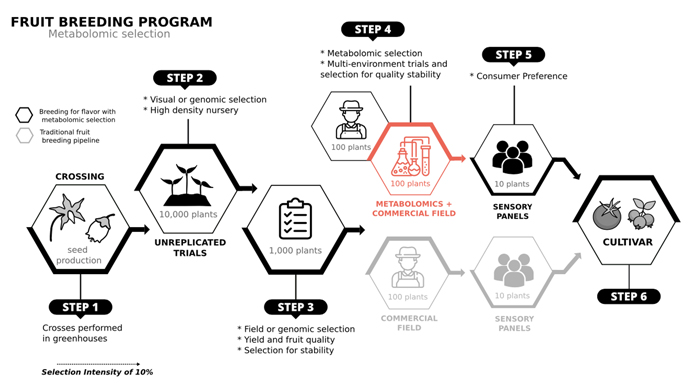
However, mining for that perfect mingling of flavour is no easy task, folks. For starters, breeding programmes for fruit and vegetables need to make sure they are hitting the sweet spot for all of their consumer bases. Working for the greater good of the whole has its downside though, since it often means corners need to be cut. “Creating the optimal genetic combination that covers all these traits is difficult, so breeding programs often deprioritize flavor to focus on improving disease resistance and increasing yield”, the researchers explained.
Another complicated task that these crop breeders face is being able to evaluate and select from hundreds to thousands of potential varieties. It’s not a simple touch-and-go process either, as testing one single sample can get you in quite a pickle—especially since we’re trying to be as objective as possible here. The requisite for consumer panels is around 100 people, which can be expensive and impractical to arrange.
As with most research currently, time and money are the main foes. That’s where AI comes to save the day, and the future of fruits. By developing an algorithm to help them, the researchers managed to “streamline this process [and] predict how consumers will rank flavor in tomatoes and blueberries,” for example.
“We created a database containing all known compounds associated with flavor in all varieties of these fruits. Then, we compared this database with existing consumer panel ratings on sweetness, sourness, umami and overall flavor and preference of different varieties,” the team further elaborated. By looking at the consumer ratings alongside the chemical makeup of fruits, they were able to determine which compounds most influence flavour perception.
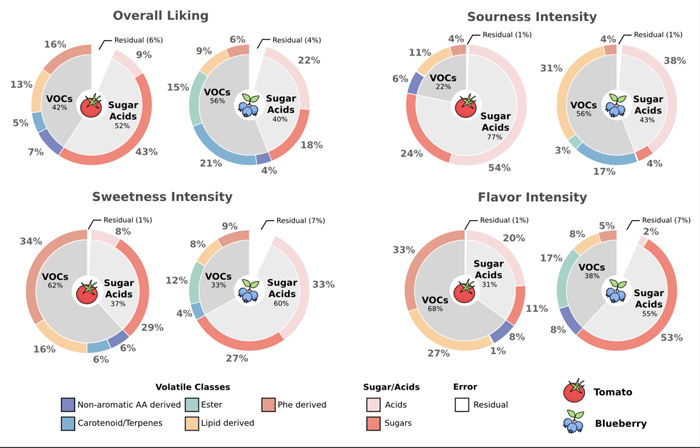
Finally, the results came in and it was found that “volatile organic compounds, or chemicals that form a gas” (which are responsible for aroma) are a big reason why certain people may like a specific variety of fruit. It’s estimated that out of a given variety of tomato or blueberry, between 42 per cent and 56 per cent of the overall preference score was associated with aroma.
That’s not all, volatile compounds contributed anything between 33 per cent to 62 per cent of how consumers rated sweetness. Furthermore, the researchers were able to identify several different chemical compounds that most contribute to the beloved flavour and sweetness perception in tomatoes and blueberries.
Keeping in mind that genetic and cultural factors are at play here, it’s exciting to think about what more this study will reveal about our preferences in fruits and vegetables. Flavour preferences will likely differ across countries, ethnic backgrounds and more, while the current results we looked at here were focused on the average US citizen’s taste.
Among the next steps for Resende and Klee’s research is “breeding fruits to increase the key volatile compounds that determine how much a consumer likes a particular variety.” Hopefully, that means we will soon find the answer to what exactly makes the perfect tomato so perfect indeed.
