The US Supreme Court has entered its authoritarian era, even AOC says so



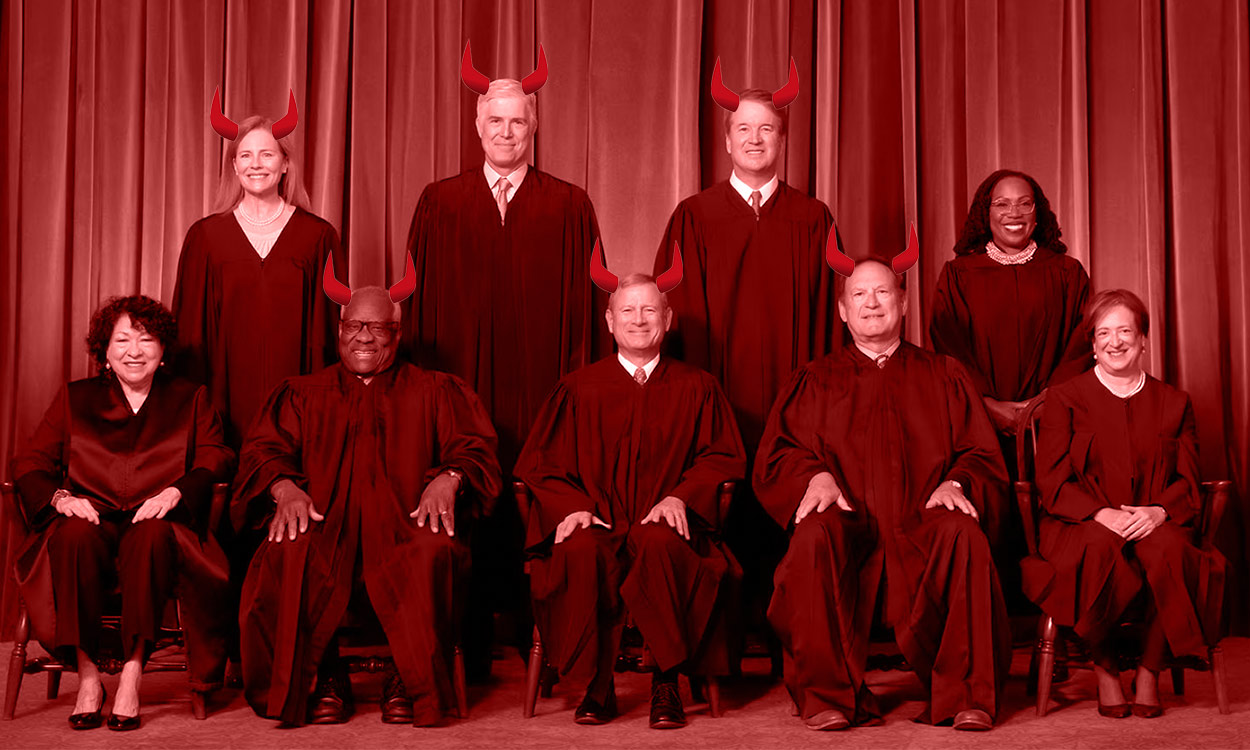
On Sunday 2 July 2023, congresswoman Alexandria Ocasio Cortez (AOC) made a public statement during a recent TV appearance in which she asserted that the US Supreme Court—who’ve been progressively exerting a conservative standpoint—was “creeping dangerously towards authoritarianism.”
The politician went on to state: “We have a broad level of tools to deal with misconduct, overreach, and abuse of power, and the Supreme Court has not been receiving the adequate oversight necessary in order to preserve their own legitimacy. We truly believe that Congress has given the President this authority. The Supreme Court is far overreaching their authority. And I believe, frankly, that we really need to be having conversations about judicial review as a check on the courts as well.”
AOC’s comments were made directly in relation to the Court’s recent decision to strike down President Biden’s student loan relief programme, as well as the justice’s other highly controversial rulings regarding affirmative action and the rights of LGBTQIA+ individuals.
It almost feels as though ever since the Supreme Court overturned Roe v. Wade in June 2022, we’ve seen a tidal wave of conservative decisions, all of which have further reduced and erased the rights of marginalised groups within the country.
The Supreme Court is currently made up of a six – three justice majority, with what would be labeled as socially conservative judges dominating the rulings. Two of the longest standing justices are currently facing ethics reviews. According to The Guardian, Justice Samuel Alito is accused of not disclosing gifts from a rightwing billionaire who lobbied for the Court to end Biden’s loan relief programme while Justice Clarence Thomas has been accused of taking undeclared gifts as well as a number of alleged sexual transgressions and harrasment claims.
On top of this, a number of Democrats and media outlets alike have accused the Supreme Court of overstepping their bounds, and attempting to legislate and act as a congressional body, rather than an unbiased judicial system.
The Supreme Court is a complicated machine, so let’s break down what exactly their recent decisions mean, and how they’ll impact the most vulnerable people in the US.
How will the Supreme Court’s rulings on Biden’s student relief loan plan impact people?
In short, Biden had written up a three-part plan to alleviate the burden of student loans for low-to-middle income borrowers. If it had been approved, the plan would’ve massively helped to make student loans more manageable for hundreds of thousands of Americans.
Moreover, Biden had the congressional power to push the plan through. The Higher Education Relief Opportunities for Students Act (HEROES Act) explicitly states that the Education Department can “waive or modify” financial assistance programmes “as the Secretary deems necessary” in a national emergency, as reported by Vox.
In true liberal queen energy, Justice Elena Kagan dissented from the ruling—meaning that she submitted an opinion open letter expressing her disagreement with the majority—writing “the result here is that the Court substitutes itself for Congress and the Executive Branch in making national policy about student loan forgiveness.”
As it stands, there’s no comprehensive student loan easing, and with the Court looking as it now, it’s doubtful there’ll be one in the near future.
How will the Supreme Court’s rulings on affirmative action impact people?
Another arguably even more crushing ruling concerns the role of affirmative action at the collegiate level. On Sunday, the Court also ruled that race-based admissions are officially unconstitutional—subsequently jeopradising the academic careers of hundreds of thousands of POC students.
According to the BBC, Biden asserted that he strongly disagreed with the Supreme Court’s ruling, noting that the current ideological makeup of the Court is “not normal.”
Racial discrimination is still rife in the US, particularly within the academic and job sectors. Completely banishing affirmative action will undeniably negatively impact a large majority of people. A recent investigation from The Guardian explicitly proved that elite universities in the US and the UK still had pervasive issues with racial and class-based discrimination and ostracisation.
It’s not hard to see that the Supreme Court is officialy in its authoritarian era. We’re frequently noticing religious and so-called ‘moral’ values being placed above the basic human rights of marginalised individuals and communities. Moreover, there seems to be little to nothing being done from the other government branches to properly address these imbalances. The Supreme Court has always been a pretty indestructible fortress, but it’s time we punch the shit out of those walls and seriously rethink the entire system.
