New report reveals that the Met Police is rotten and riddled with toxic cultures. Can anything be done?



That’s it everyone—it’s now officially been stated. The Met Police is riddled with bullying, poor leadership, misogyny, and its “rotten” treatment of black people.
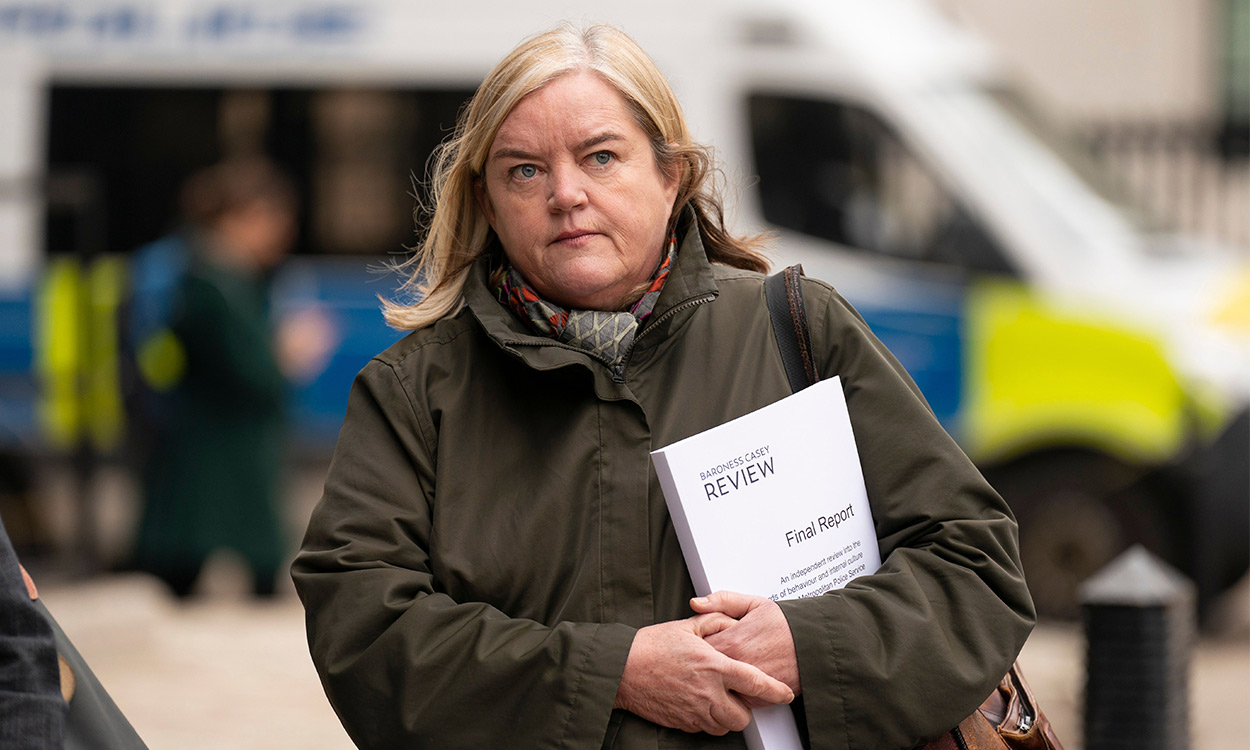
Following the abduction, rape, and murder of Sarah Everard by a serving Met Police officer back in March 2021, Baroness Dame Louise Casey was appointed to lead an independent review into standards within the police force responsible for law enforcement and the prevention of crime in Greater London.
Even before the government official—who specialises in social welfare—released her 363-page report on Tuesday 21 March 2023, things hadn’t been looking good for forces across the country. A 2022 report commissioned by the former Home Secretary, Priti Patel, had found that hundreds of individuals who should have failed their vetting checks were in fact serving as active police officers.
Around the same time, government figures also indicated that mass numbers of officers were leaving UK law enforcement, clearly a symptom of the depreciating standards in leadership. Everard’s brutal killing undeniably shed light on the police’s highly worrying inefficiency to deal with misogyny and misconduct within its own ranks, in turn putting all of us at risk.
Dame Casey’s final report has revealed disturbing details of sexual assaults, more often than not covered up or downplayed, with 12 per cent of women in the Met saying they had been harassed or attacked at work, and one-third experiencing sexism.
The government went as far as saying that the capital’s police service may have more officers like the killer Wayne Couzens and serial rapist David Carrick. No matter how terrifying this statement is, it’s also far from surprising when looking at the Met’s poor leadership and organisation.
And it seems that Dame Casey’s review also blames Londoners’ lack of confidence in its law enforcement—with just 50 per cent of the public expressing confidence even before revelations about the force’s worst recent scandals—on its past leadership.
“Public respect has fallen to a low point. Londoners who do not have confidence in the Met outnumber those who do, and these measures have been lower amongst black Londoners for years,” she wrote, continuing, “The Met has yet to free itself of institutional racism. Public consent is broken. The Met has become unanchored from the Peelian principle of policing by consent set out when it was established.”
The report highlighted a bullying culture, one that leaves frontline officers demoralised and feeling let down by their leaders, with discrimination “baked into the system.” Not only are Met officers harassing women, black people, and many other citizens, but they’re also often victims themselves.
Dame Casey revealed that one Muslim officer had bacon stuffed in his boots, and a Sikh officer had his beard cut. It was pointed out that minority ethnic officers were much more likely to be disciplined or leave, and that Britain’s biggest force remains disproportionately white in a city that is increasingly diverse.
In a news briefing held to unveil what she described as “very grave and serious” findings, Dame Casey aptly asked, “What would it take for policing to wake up that it has to be different?” It’s clear to see that the Met Police is failing on so many levels that even a complete restructuring and a radical shake-up might not be enough to change anything.
London mayor Sadiq Khan—who, it should be noted, had not used the word “institutionally” once when speaking about the prejudice in the force he’s been overseeing ever since coming to power in 2016—made it obvious that he agrees with Dame Casey’s verdicts.
“The evidence is damning. Baroness Casey has found institutional racism, misogyny and homophobia, which I accept. I’ll be unflinching in my resolve to support and hold the new commissioner to account as he works to overhaul the force,” Khan said following the recent release of the review.
On the other hand, although Sir Mark Rowley, the force’s commissioner since September 2022, said he accepted the report’s factual findings about racism, misogyny, and homophobia in his organisation, the commissioner also added that he wanted more time to study Dame Casey’s recommendations. In fact, Sir Rowley went as far as to point blank refuse to admit that such findings were “institutional.”
“I have to use practical, unambiguous, apolitical language… I don’t think it fits those criteria. It’s simply a term I’m not going to use myself,” he said. It’s pretty evident that the Met police, a public institution once considered the backbone of the UK, is truly past the point of saving.
