Reinventing Cities competitors create carbon-free cities for the future



As a zero carbon emitting future seems to be the only option available to us if we intend to reverse the damages of climate change (and the looming end of the world), an international competition for innovative carbon-free urban projects has been making headlines for the forward looking and inspirational proposals that have been submitted by its competitors.
With buildings being responsible for around the 40 percent of the carbon emissions present in our urban environments, the design of sustainable and less consuming dwellings is a solid and long long-term solution, and certainly a priority in the save-the-world-from-climate-change to-do list. As cities grow bigger, it goes without saying that it is precisely from the city that we need to start rethinking the ways we build and live in urban spaces. It is from this urgency that the Reinventing Cities competition has been calling for carbon-neutral urban and architectural projects to regenerate vacant or abandoned sites in several cities around the world.
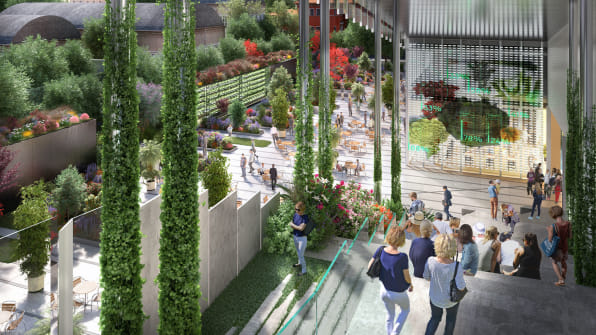
Mostly depicted with the usual perfect rendering of happy digital citizens, the submitted proposals had to demonstrate sustainability (of course), and most importantly resilience, in an attempt to negate the urban ethos of ‘bulldoze and rebuild’ that has been trending in the last decades.
Reinventing Cities was founded by the C40 Cities Climate Leadership Group, a network of mayors from all over the world as well local governments keen to find solutions to climate change by focusing on cities, and with the support of Climate KIC and ofo (the Chinese bike sharing company). The competition operates on the basis of ‘think global, act local’, while promoting a successful alliance between public and private institutions when it comes to solving urgent issues such, like the ever looming climate crisis.
For the second edition of Reinventing Cities, the competition’s board have marked underutilised spaces in 14 cities, among which are Chicago, Madrid, Milan, Oslo, and Reykjavík. Car parks, unused buildings, old mansions, abandoned markets, an airport site, and a former landfill were part of the 31 sites included in the list of spaces to be redeveloped by the competing teams. Alongside architects and developers, the participants included local community groups, environmentalist, and artists to make sure that the creative processes included a balanced variety of skills to inform thought-provoking ideas.
Among the winning projects, whose prize is to be able to buy or lease each site, there is the plan for an ultra-efficient building in Chicago where inhabitants could grow food on the roof and process stormwater on site. At the Mercado Habitado II in Madrid, an unused market in the Spanish city would be renovated with recycled materials and produce its own power via solar panels applied on its roof and walls. Inside the market, the community would have access to local and organic products.
In-house renewable energy systems, urban farming, co-living, and co-working spaces are ubiquitous features in almost every project submitted. Some even included workshops about climate change and studios for startups and non-profit organisations to work on sustainability projects on site.
Not everything about Reinventing Cities is perfect though. Most of the selected cities reside within the western hemisphere, leaving behind the cities whose urban challenges and consequential solutions are systematically different from the ones addressed within the proposals. Moreover, the urban history of our cities has taught us that just because an urban plan is sustainable does not mean it respects the fragile social balance of the communities that reside within it.
Despite the competition’s shortcoming in being as global as it claims to be, and at times its rather privileged urban projects, the ideas generated through the competition are inspiring prototypes of what future cities could look like. If we decide to shift the usual market-driven attitude of urban development to one that prioritises regeneration over reconstruction, and communities’ well-being over profit, the cities of the future could really be places of hope. Utopic renderings aside, Reinventing Cities could be used as an open source platform for gathering sustainable urban models that could be replicated in today’s and tomorrow’s urban projects.
